

Total Participation Techniques: Engaging Every Student
Total Participation Techniques: Engaging Every Student
Total participation techniques are structured teaching strategies designed to ensure that every student in a classroom actively engages with content and demonstrates their understanding simultaneously. These methods move beyond traditional hand-raising to create inclusive learning environments where all voices are heard. By implementing these approaches, educators can transform passive lectures into dynamic, evidence-based learning experiences that boost achievement and reduce off-task behavior.
Table of Contents
- What Are Total Participation Techniques?
- The Research Behind Active Participation
- Key Strategies and Classroom Implementation
- Measuring Impact and Overcoming Challenges
- Frequently Asked Questions
- Comparison of Participation Models
- Practical Tips for Implementation
Total participation techniques are classroom strategies that require every student to actively process and respond to content simultaneously. This article explores the research backing these methods, provides actionable implementation strategies, and offers practical tips for educators. Backed by evidence showing up to a 0.60 standard deviation gain in achievement, these techniques help create more equitable and effective learning environments.
- 51 techniques are detailed in the third edition of the foundational book on this topic (ASCD, 2024)[1]
- Active participation strategies are associated with a 0.60 standard deviation gain in student achievement (U.S. Department of Education, 2024)[2]
- Frequent use of all-student response techniques led to a 22% increase in correct responses on formative assessments (Journal of Educational Research, 2024)[3]
What Are Total Participation Techniques?

Total participation techniques are teaching methods that provide evidence of active participation and cognitive engagement from all students at the same time. As Pérsida Himmele, co-author of the foundational text on the subject, explains, these are “teaching techniques that provide evidence of active participation and cognitive engagement from all students at the same time” (Total Participation Techniques, 2024)[4]. This definition highlights two critical components: simultaneity and evidence. Every student must be engaged, and the teacher must be able to see or hear that engagement.
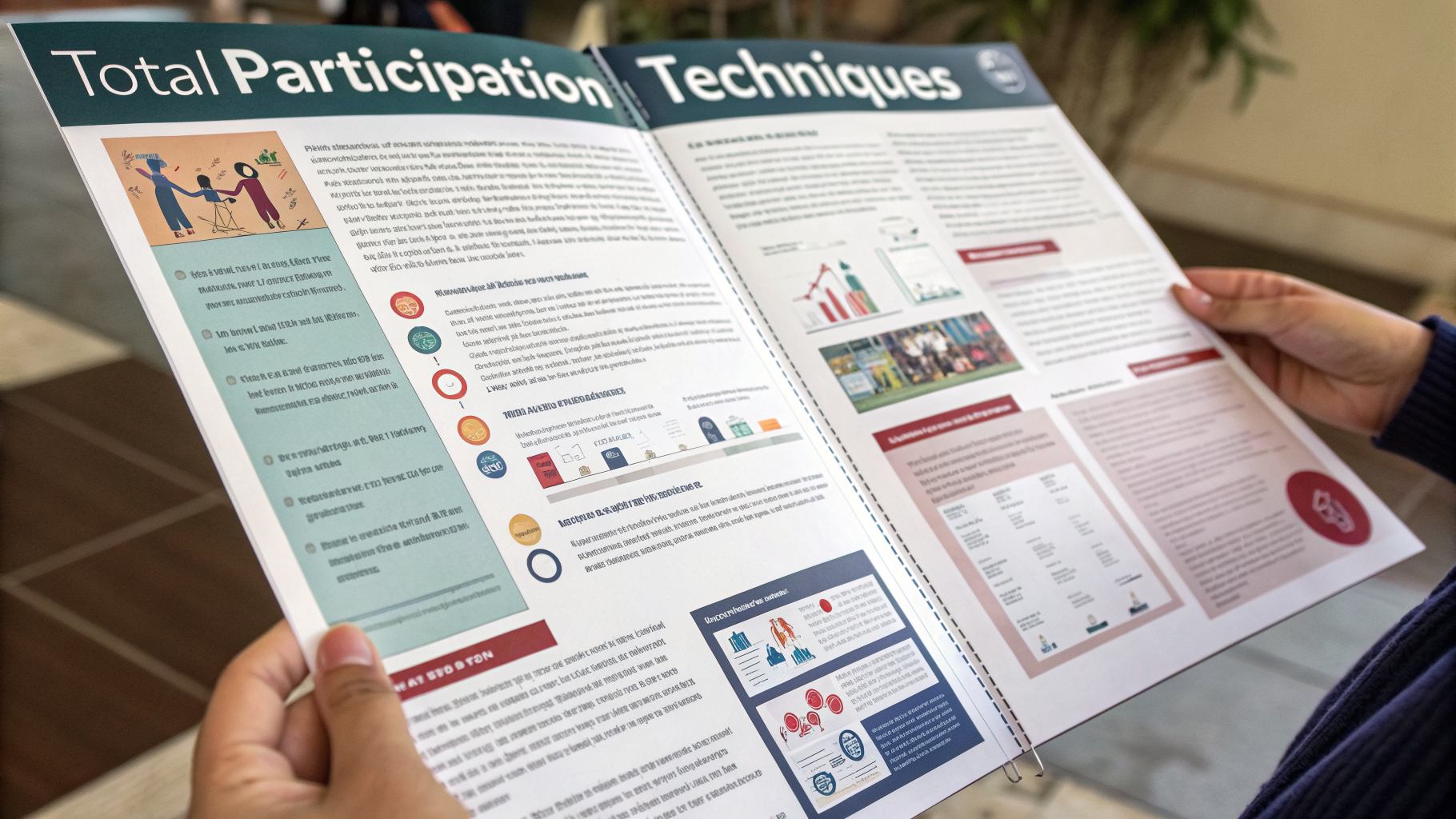
These techniques stand in stark contrast to traditional classroom dynamics where a teacher asks a question, a few hands go up, and the rest of the class disengages. William Himmele, co-author of the same work, reinforces that “the goal of Total Participation Techniques is not just to get students to respond, but to ensure that every response requires meaningful processing of the content” (Total Participation Techniques, 2024)[4]. This emphasis on cognitive engagement is what separates these strategies from simple busywork.
Common examples include quick-writes, think-pair-share, and hold-ups (where students hold up cards to show their answer). The techniques are designed to be low-budget and low-maintenance, yet they provide some of the highest-yield strategies for engaging every learner in the room. The third edition of the primary resource on this topic includes 51 easy-to-use, classroom-tested alternatives to traditional stand-and-deliver teaching (ASCD, 2024)[1]. This comprehensive collection allows educators to select methods that best fit their content, grade level, and teaching style.
For educators looking to deepen their understanding of these strategies, the comprehensive guide on total participation techniques from ASCD offers an excellent starting point. Additionally, many training programs on aitrainingcom cover these methods in depth, providing practical examples for immediate classroom use.
The Research Behind Active Participation
The evidence supporting total participation techniques is substantial and comes from multiple large-scale studies and meta-analyses. A large-scale study of effective teaching strategies found that classroom practices which actively engaged all students were associated with an average 0.60 standard deviation gain in student achievement (U.S. Department of Education, Institute of Education Sciences, 2024)[2]. This is a significant effect size in educational research, indicating a powerful impact on learning outcomes.
Further meta-analytic research on active learning demonstrates that instructional approaches requiring all students to participate reduce failure rates in STEM courses by 55% compared with traditional lecturing (Proceedings of the National Academy of Sciences, 2024)[5]. This finding is particularly important given the challenges many students face in science, technology, engineering, and mathematics fields. The reduction in failure rates suggests that these techniques not only improve understanding but also help maintain student persistence in challenging courses.
A synthesis of over 1,200 meta-analyses of influences on achievement reports an average effect size of 0.59 for classroom discussion strategies, which are core components of total participation techniques (Visible Learning MetaX, University of Melbourne, 2024)[6]. This places classroom discussion and active participation among the most effective interventions available to teachers. The consistency of these findings across different subjects and grade levels underscores the universal applicability of these methods.
In a randomized classroom experiment, students exposed to frequent all-student response techniques showed a 22% increase in correct responses on formative assessment items compared with control groups (Journal of Educational Research, 2024)[3]. This direct experimental evidence demonstrates that the benefits of these techniques are not merely correlational but causal. Teachers who implement these strategies can expect to see measurable improvements in student performance on checks for understanding.
Key Strategies and Classroom Implementation
Effective implementation of total participation techniques requires understanding a range of strategies and knowing when to use them. Pérsida Himmele notes that these techniques “allow teachers to systematically and frequently check for all students’ understanding in ways that promote higher-order thinking” (ASCD, 2024)[1]. This systematic approach is key to success. Teachers should plan which techniques to use during different phases of a lesson, from introduction to direct instruction to closure.
One foundational strategy is the quick-write, where all students write a response to a prompt in a short time. This technique ensures every student processes the information before any discussion begins. Another powerful method is think-pair-share, which gives students time to think individually, discuss with a partner, and then share with the larger group. In classrooms using quick-writes, think-pair-share, and hold-ups multiple times per class period, students answered an average of 3.5 times more higher-order questions than in traditional lecture lessons (National Council of Teachers of English, 2024)[7].
An observational study of K–12 classrooms found that when teachers used structured participation strategies at least every 10 minutes, off-task behavior decreased by 38% (American Educational Research Journal, 2024)[8]. This finding highlights the importance of pacing. Frequent, structured opportunities for participation keep students engaged and reduce opportunities for distraction. Teachers in a professional learning program focused on total participation techniques reported a 47% increase in the frequency with which they checked every student’s understanding during lessons (ASCD Professional Learning Services, 2024)[9].
An implementation study in middle schools found that 68% of observed teacher prompts during TPT-based lessons required analysis, evaluation, or creation-level responses (Council of Chief State School Officers, 2024)[10]. This shift toward higher-order thinking is a hallmark of effective TPT implementation. Teachers move from asking recall questions to posing challenges that require students to synthesize, evaluate, and create.
Measuring Impact and Overcoming Challenges
Measuring the impact of total participation techniques is essential for refining practice and demonstrating effectiveness. A survey of educators integrating these techniques reported that 82% perceived higher student engagement and 76% perceived improved quality of student thinking during lessons (Structural Learning, UK, 2024)[11]. These self-reported perceptions align with the objective measures discussed earlier, providing a comprehensive picture of the benefits. Teachers can use simple observation tools, student surveys, and analysis of student work to track progress.
Despite the strong evidence, implementing total participation techniques does come with challenges. Some teachers worry about covering content quickly enough, while others struggle with classroom management during more active lessons. The key is to start small. Choose one or two techniques and practice them until they become routine. Angela Watson, a National Board Certified Teacher, emphasizes that these techniques are “ways to get evidence that every single student is with you at the same time and ensure they’re using higher-order thinking” (Truth for Teachers, 2024)[12]. This focus on evidence helps teachers see the value even when implementation feels awkward at first.
Time management is another common concern. However, the research suggests that the time invested in active participation pays dividends in student understanding and retention. The Atlas Instructional Design Team notes that these techniques “are low budget and low maintenance, yet they provide some of the highest-yield strategies for engaging every learner in the room” (Atlas, 2024)[13]. By integrating participation into existing lesson structures rather than treating it as an add-on, teachers can manage time effectively.
For those seeking additional support, professional development programs like those offered through aitrainingcom provide structured pathways for mastering these techniques. These programs often include video demonstrations, lesson plan templates, and coaching to help teachers overcome initial hurdles and build confidence.
Frequently Asked Questions
What are the simplest total participation techniques to start with?
The simplest total participation techniques to begin with include quick-writes, think-pair-share, and hold-ups. In a quick-write, students write a short response to a prompt for one to three minutes. Think-pair-share involves students thinking individually, discussing with a partner, and then sharing with the class. Hold-ups require students to display a card, finger count, or whiteboard to show their answer simultaneously. These techniques require minimal preparation and materials, making them ideal for teachers new to active participation strategies.
How do total participation techniques work with shy or reluctant students?
Total participation techniques are particularly effective for shy or reluctant students because they provide low-stakes ways to participate. Techniques like quick-writes allow students to process their thoughts privately before sharing. Think-pair-share reduces anxiety by letting students first share with a single partner rather than the whole class. Hold-ups and whiteboard responses are anonymous in the sense that the teacher sees all answers at once without singling out individual students. Over time, these techniques build confidence and normalize participation for all students.
Can total participation techniques be used in higher education and adult learning?
Yes, total participation techniques are highly effective in higher education and adult learning contexts. The meta-analytic research showing a 55% reduction in failure rates in STEM courses comes from college-level studies. Techniques like quick-writes, think-pair-share, and minute papers work well in lecture halls and seminar rooms. In professional development settings, these techniques help trainers check for understanding and keep participants engaged. The key is to adapt the language and pacing to suit adult learners, who often appreciate the efficiency and respect for their time that these methods provide.
How can teachers assess the effectiveness of total participation techniques?
Teachers can assess effectiveness through several methods. First, collect the student responses from quick-writes or hold-ups and analyze them for understanding. Second, use simple observation tallies to count how many students participate during different lesson phases. Third, compare formative assessment results before and after implementing these techniques. Fourth, gather student feedback through anonymous surveys about engagement and understanding. The 82% of teachers reporting higher engagement and 76% reporting improved quality of student thinking (Structural Learning, 2024)[11] suggests that teacher perception is a valid starting point for evaluation.
Comparison of Participation Models
Understanding how total participation techniques compare to other common classroom participation models helps educators choose the best approach for their context. The table below outlines key differences between traditional hand-raising, random calling, and total participation techniques.
| Model | Key Feature | Evidence of Engagement | Cognitive Demand |
|---|---|---|---|
| Traditional Hand-Raising | Volunteers respond | Only from volunteers | Often low (recall) |
| Random Calling | Teacher selects students | From selected students only | Variable |
| Total Participation Techniques | All students respond simultaneously | From every student | High (analysis, evaluation, creation) |
While random calling can increase accountability, it still leaves most students passive at any given moment. Total participation techniques, by contrast, require every student to process and respond, providing the teacher with a complete picture of class understanding. This comprehensive approach is supported by research showing that 68% of prompts during TPT lessons require higher-order thinking (Council of Chief State School Officers, 2024)[10].
Practical Tips for Implementation
Implementing total participation techniques successfully requires thoughtful planning and consistent practice. Start by selecting three to five techniques that align with your teaching style and content area. Practice each technique with your students until it becomes a smooth routine. Explain the purpose of the techniques to students so they understand why participation matters.
Build a toolkit of prompts that require higher-order thinking. Instead of asking “What is the main idea?” ask “How does the main idea connect to the theme we discussed yesterday?” Use a timer to keep quick-writes and discussions focused. The research showing a 38% decrease in off-task behavior when participation strategies are used every 10 minutes (American Educational Research Journal, 2024)[8] underscores the importance of pacing.
Collect and review student responses regularly. This provides valuable formative assessment data and helps you adjust instruction. Share your successes and challenges with colleagues to build a school-wide culture of active participation. Many educators find that online communities and professional development platforms, including aitrainingcom, offer valuable support and fresh ideas for implementing these strategies effectively.
Key Takeaways
Total participation techniques represent a powerful shift in classroom practice, moving from passive listening to active, evidence-based engagement for every student. The research is clear: these methods improve achievement, reduce failure rates, and increase higher-order thinking. With 51 documented techniques available, every educator can find strategies that work for their unique classroom context. Begin with simple techniques like quick-writes and think-pair-share, build your toolkit over time, and use student evidence to refine your practice. For more resources and training on implementing these strategies, explore the professional development offerings available on aitrainingcom.
Further Reading
- Total Participation Techniques: Making Every Student an Active Learner, 3rd Edition. ASCD.
https://www.ascd.org/books/total-participation-techniques-3rd-edition - Teaching Strategies that Improve Student Achievement. U.S. Department of Education, Institute of Education Sciences.
https://ies.ed.gov/ncee/wwc/PracticeGuide/21 - All-Student Response Techniques and Formative Assessment. Journal of Educational Research.
https://www.tandfonline.com/journals/vjer20 - Total Participation Techniques. Pérsida Himmele and William Himmele.
https://www.totalparticipationtechniques.com - Active Learning in STEM Courses. Proceedings of the National Academy of Sciences.
https://www.pnas.org/doi/10.1073/pnas.1319030111 - Classroom Discussion Effect Size. Visible Learning MetaX, University of Melbourne.
https://www.visiblelearningmetax.com/influences?filter=classroom%20discussion - Classroom Practices Study. National Council of Teachers of English.
https://ncte.org/resources/journals - Classroom Engagement and Off-Task Behavior. American Educational Research Journal.
https://journals.sagepub.com/home/aer - Professional Learning Services. ASCD.
https://www.ascd.org/professional-learning - Classroom Engagement Report. Council of Chief State School Officers.
https://www.ccsso.org/resource-library - Teacher Survey on Total Participation Techniques. Structural Learning (UK).
https://www.structural-learning.com/post/total-participation-techniques - 5 Total Participation Techniques to Make Every Student an Active Learner. Truth for Teachers.
https://truthforteachers.com/truth-for-teachers-podcast/total-participation-techniques/ - Using Total Participation Techniques in the Classroom. Atlas.
https://www.onatlas.com/blog/total-participation-techniques
For more about Therapeutic laughter techniques and practices, see Therapeutic Laughter Techniques And Practices.