
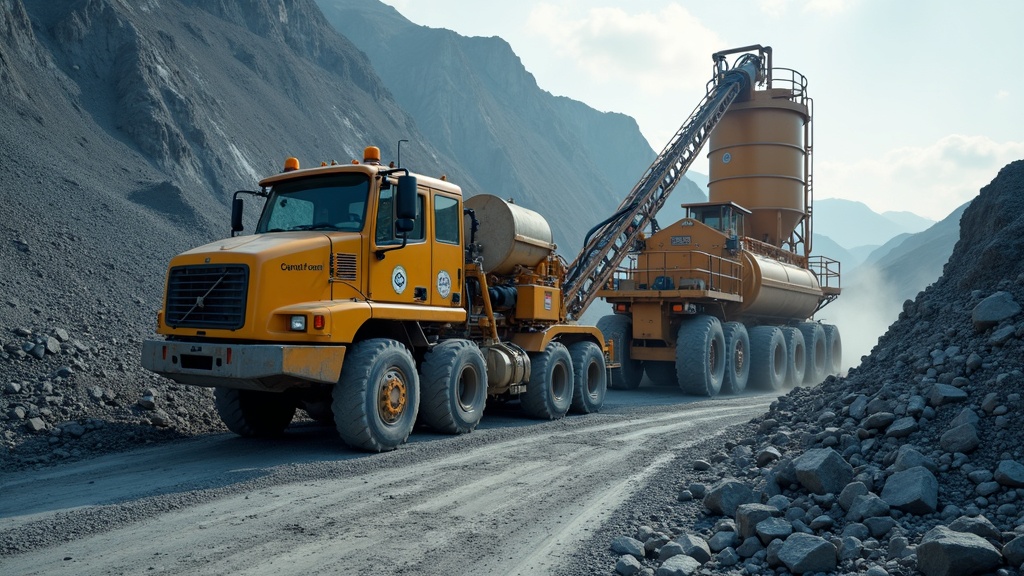
Colloidal Grout Mixing Equipment in Mining Overview
This overview examines colloidal grout mixing equipment in mining, detailing how high-shear mixers improve grout quality, penetration, and cost-efficiency for underground consolidation and water control.
Table of Contents
- The Role of High-Shear Mixing in Mining Grouting Operations
- How Colloidal Grout Mixing Equipment Achieves Superior Particle Dispersion
- Operational and Cost Benefits of Colloidal Grout Plants in Underground Mining
- Selecting and Integrating Colloidal Grout Mixing Equipment for Mining Projects
- Important Questions About Colloidal Grout Mixing Equipment in Mining Overview
- Comparison: Colloidal Mixers vs. Conventional Paddle and Drum Mixers
- Practical Tips for Implementing Colloidal Grout Mixing in Mining
- Key Takeaways
Colloidal grout mixing equipment in mining is a high-shear system that disperses cement particles into a stable, colloidal suspension, producing a homogeneous grout with superior strength, reduced bleed, and enhanced pumpability for underground applications.
Colloidal Grout Mixing Equipment in Mining Overview in Context
- High-shear colloidal mixers can reduce cement content in the A-component grout by 10 percent while maintaining performance, lowering material costs for mining grouting operations (SIMEM Underground Solutions, 2026)[1].
- Colloidal grout plants produce grout with particle sizes of only a few microns, significantly finer than conventional equipment, allowing deeper penetration into mining rock fractures (Amix Systems Ltd., 2026)[2].
- Standard drum mixers used for grout in mining can leave dry clumps in the slurry, which compromises final strength compared with colloidal grout plants that achieve complete dispersion of cement particles (GroutMixing.com, 2026)[3].
Colloidal grout mixing equipment in mining has become a critical technology for underground operations where grout quality directly determines the success of ground consolidation, water control, and structural support. Unlike conventional paddle or drum mixers, colloidal systems use high-shear forces to break down cement agglomerates into individual particles, creating a stable suspension that penetrates micro-fractures in rock formations. This article provides an overview of how this equipment works, its operational benefits, selection criteria, and practical implementation tips for mining and tunneling projects.
The Role of High-Shear Mixing in Mining Grouting Operations
High-shear mixing is the defining principle behind colloidal grout mixing equipment in mining. In underground environments, grout must fill voids, stabilize fractured rock, and control groundwater inflow. The quality of the grout mixture directly affects its ability to perform these tasks. Colloidal mixers generate intense hydraulic shear forces within a specially designed chamber, forcing the grout components through a narrow gap at high velocity. This action breaks down cement clumps into particles on the order of 5 microns, as reported by Amix Systems Ltd. (2026)[2], creating a homogeneous slurry with vastly increased surface area for hydration. The result is a grout that exhibits higher compressive strength, lower bleed, and better pumpability compared with grout produced by conventional paddle mixers. Michael S. Burkhard, Principal Engineer at SIMEM Underground Solutions, stated: “Both lab and field results have demonstrated the superior mixing capabilities of a high shear colloidal mixer versus a paddle type mixer, delivering higher strengths and lower bleed in cementitious grouts” (2026)[1]. For mining operations, this means more reliable ground support and reduced risk of grout failure in critical applications such as shaft lining, tunnel backfilling, and rock bolt anchoring. The adoption of colloidal grout mixing equipment for mining and tunneling is therefore driven by the need for consistent, high-performance grout in demanding underground conditions.
How Colloidal Grout Mixing Equipment Achieves Superior Particle Dispersion
The mechanism of particle dispersion in colloidal grout mixing equipment in mining relies on a high-velocity mixing chamber that creates intense cavitation and shear forces. Unlike standard drum mixers that rely on tumbling action, colloidal mixers force the grout through a rotor-stator assembly where the gap is precisely controlled. The Technical Team at Amix Systems Ltd. explained: “In mining applications, a colloidal grout plant produces grout with enhanced penetration, reduced bleed, and improved pumpability, which directly translates into more effective ground consolidation and water control in underground workings” (2026)[2]. The high-shear action completely disperses cement particles, eliminating the dry clumps that often remain in conventionally mixed grout. The Technical Editorial Board at GroutMixing.com noted: “The primary benefit of colloidal grout mixing plants is the complete dispersion of cement particles; standard drum mixers often leave dry clumps within the slurry, which weakens the final cured product in demanding environments such as underground mines” (2026)[3]. This complete dispersion ensures that every particle is wetted and available for hydration, maximizing the grout’s binding properties. For mining operations dealing with fractured rock formations, the ability of colloidal grout to penetrate micro-fractures is a decisive advantage over conventional mixing approaches.
The Physics of Colloidal Grout Formation
The process begins when cement and water enter the mixing chamber. The rotor, spinning at high speed, accelerates the mixture and forces it through the stator’s openings. This action creates a pressure differential that collapses cavitation bubbles, generating localized shock waves that further break down particle agglomerates. The resulting slurry is a true colloidal suspension where cement hydrates remain dispersed and stable, preventing sedimentation and bleed. As the SIMEM Underground Solutions Engineering Department reported: “By creating cement hydrates of colloidal size and forming a stable suspension, high-shear colloidal grout mixers can reduce the cement content in the A-component by up to ten percent while maintaining performance, a significant cost advantage for large underground mining grouting programs” (2026)[1]. This stability is essential for maintaining grout quality during transport over long pumping distances underground.
Operational and Cost Benefits of Colloidal Grout Plants in Underground Mining
Adopting colloidal grout mixing equipment in mining delivers measurable operational and financial advantages. The most significant benefit is the reduction in cement consumption. By achieving a stable colloidal suspension, the same grout performance can be maintained with up to 10 percent less cement in the A-component, as documented by SIMEM Underground Solutions (2026)[1]. For large mining projects that consume thousands of tons of cement annually, this reduction translates into substantial cost savings. Additionally, the enhanced pumpability of colloidally mixed grout allows for longer pumping distances, reducing the need for intermediate pump stations and simplifying logistics underground. The reduced bleed characteristic is particularly important for water control applications, where bleed water can create pathways for groundwater ingress. The Product Engineering Team at Amix Systems Ltd. emphasized: “For fractured rock formations and complex ore bodies, colloidal grout plants deliver a homogeneous mixture with superior particle dispersion, allowing the grout to penetrate micro-fractures that conventional paddle mixers simply cannot treat effectively” (2026)[2]. This superior penetration capability reduces the number of grout holes required and improves the overall effectiveness of the grouting program. Furthermore, the consistency of colloidal mixing reduces waste and rework, contributing to more predictable project timelines and budgets. For mining companies focused on operational efficiency, the investment in colloidal equipment is often recouped through material savings alone. Understanding these benefits is essential for any real work ai adoption training people program that seeks to modernize mining operations.
Selecting and Integrating Colloidal Grout Mixing Equipment for Mining Projects
Choosing the right colloidal grout mixing equipment in mining requires careful evaluation of project-specific parameters. Key factors include the required grout output volume, the type of cement and additives used, the pumping distance, and the site’s power supply. Colloidal grout plants come in various sizes, from portable units for small-scale grouting to large, stationary plants for major tunneling and shaft-sinking projects. The selection process should begin with a thorough analysis of the grout specification, including target compressive strength, bleed limits, and setting time. Equipment manufacturers often provide test mixing services to verify that their colloidal mixers can achieve the required grout properties with the specific materials planned for the project. Integration with existing site infrastructure is also critical. Colloidal mixers can be paired with automated batching systems, grout pumps, and data logging equipment to create a fully integrated grouting plant. For mining operations that are implementing digital transformation initiatives, the ability to monitor and control the mixing process in real time is a valuable feature. Training personnel on the operation and maintenance of colloidal equipment is essential for maximizing its benefits. The ai change management in organizations framework can be applied to help mining teams adopt this new technology effectively. Proper maintenance, including regular inspection of the rotor-stator assembly and replacement of wear parts, ensures consistent performance over the life of the equipment.
Important Questions About Colloidal Grout Mixing Equipment in Mining Overview
What is the primary advantage of colloidal grout mixing equipment over conventional paddle mixers?
The primary advantage is the complete and stable dispersion of cement particles, which produces a homogeneous grout with higher compressive strength, lower bleed, and enhanced pumpability. Conventional paddle mixers often leave dry clumps in the slurry, weakening the final product. Colloidal mixers break down cement agglomerates into particles on the order of a few microns, creating a true colloidal suspension that penetrates micro-fractures in rock formations more effectively.
How much cement can be saved by using colloidal grout mixing equipment in mining operations?
According to SIMEM Underground Solutions (2026), high-shear colloidal grout mixers can reduce the cement content in the A-component grout by up to 10 percent while maintaining the same performance levels. This reduction is possible because the colloidal suspension maximizes the surface area of cement particles available for hydration, improving the efficiency of the cementitious binder. For large mining grouting programs, this can result in significant material cost savings.
Can colloidal grout mixing equipment handle the harsh conditions found in underground mines?
Yes, colloidal grout plants are specifically designed for demanding environments such as underground mines. They are built with robust components that can withstand dust, moisture, and rough handling. The high-shear mixing chamber is typically made from wear-resistant materials, and the equipment can be configured for portable or stationary use. Proper maintenance, including regular inspection of the rotor-stator assembly, ensures reliable operation in harsh mining conditions. Many manufacturers offer units with explosion-proof electrical components for use in potentially gassy mines.
What types of grout can be produced with colloidal mixing equipment for mining applications?
Colloidal grout mixing equipment can produce a wide range of grout types, including cement-based grouts, two-component grouts (such as those using sodium silicate as an accelerator), and specialty grouts with additives like bentonite or fly ash. The high-shear action is particularly beneficial for two-component grouts, where complete dispersion of the cement component is critical for achieving the desired setting time and strength development. The equipment can also handle grouts with fine fillers and admixtures used in mining for ground consolidation, water control, and backfilling.
Comparison: Colloidal Mixers vs. Conventional Paddle and Drum Mixers
Choosing between colloidal and conventional mixing technologies depends on project requirements for grout quality, penetration, and cost. The table below summarizes the key differences between these approaches as applied to mining grouting operations.
| Feature | Colloidal Grout Mixer | Conventional Paddle/Drum Mixer |
|---|---|---|
| Particle Dispersion | Complete; particles reduced to ~5 microns | Incomplete; dry clumps often remain |
| Grout Strength | Higher compressive strength | Lower, variable strength |
| Bleed | Minimal bleed | Higher bleed |
| Pumpability | Enhanced, longer pumping distances | Reduced pumpability |
| Penetration | Penetrates micro-fractures | Limited to larger voids |
| Cement Savings | Up to 10% reduction possible | No savings |
| Equipment Cost | Higher initial investment | Lower initial investment |
Colloidal mixers offer superior performance for demanding mining applications where grout quality is critical, while conventional mixers may be sufficient for less demanding tasks where cost is the primary constraint.
Practical Tips for Implementing Colloidal Grout Mixing in Mining
Implementing colloidal grout mixing equipment in mining requires careful planning and attention to detail. The following tips can help ensure a successful deployment:
- Conduct a material compatibility test: Before full-scale use, test the colloidal mixer with the specific cement, additives, and water source planned for the project. This ensures the equipment can achieve the required grout properties and identifies any potential issues with material compatibility.
- Invest in operator training: Colloidal mixers require a different skill set than conventional mixers. Provide comprehensive training on startup procedures, adjustments to the rotor-stator gap, and troubleshooting common issues. Use a structured real work ai adoption training people program to accelerate learning and competency development.
- Implement a preventive maintenance schedule: The high-shear components of colloidal mixers are subject to wear. Establish a regular maintenance schedule that includes inspection of the rotor and stator for wear, replacement of seals, and calibration of metering systems. Keep spare parts on site to minimize downtime.
- Integrate with automated batching and monitoring systems: For large mining projects, integrate the colloidal mixer with an automated batching system that precisely controls the proportions of cement, water, and additives. Add real-time monitoring of grout density, flow rate, and mixing energy to ensure consistent quality.
For more about Colloidal system, see discover colloidal system insights.
Key Takeaways
Colloidal grout mixing equipment in mining delivers a clear performance advantage over conventional mixing methods by producing a homogeneous, stable grout with superior strength, reduced bleed, and enhanced pumpability. The technology enables significant material cost savings through reduced cement consumption and improves the effectiveness of ground consolidation and water control programs in underground mines. For mining companies looking to modernize their grouting operations, investing in colloidal equipment and providing proper training is a strategic decision that pays dividends in project quality and efficiency. To learn more about how this technology can be applied to your specific mining project, explore our comprehensive resources on ai change management in organizations for technology adoption.
Further Reading
- Performance Benefits of Colloidally Mixed Two-Component Grouts. SIMEM Underground Solutions.
https://simemug.com/wp-content/uploads/Performance-Benefits-of-Colloidally-Mixed-Two-Component-Grouts.pdf - Colloidal Grout Plant: Advanced Mixing for Construction, Tunneling and Mining. Amix Systems Ltd.
https://amixsystems.com/colloidal-grout-plant/ - Colloidal Grout Plants Guide: Comparing Mixing Approaches. GroutMixing.com.
https://www.groutmixing.com/2026/06/11/colloidalgroutplants-guide/